
Gear
Instruments and equipment Russ plays and records with.
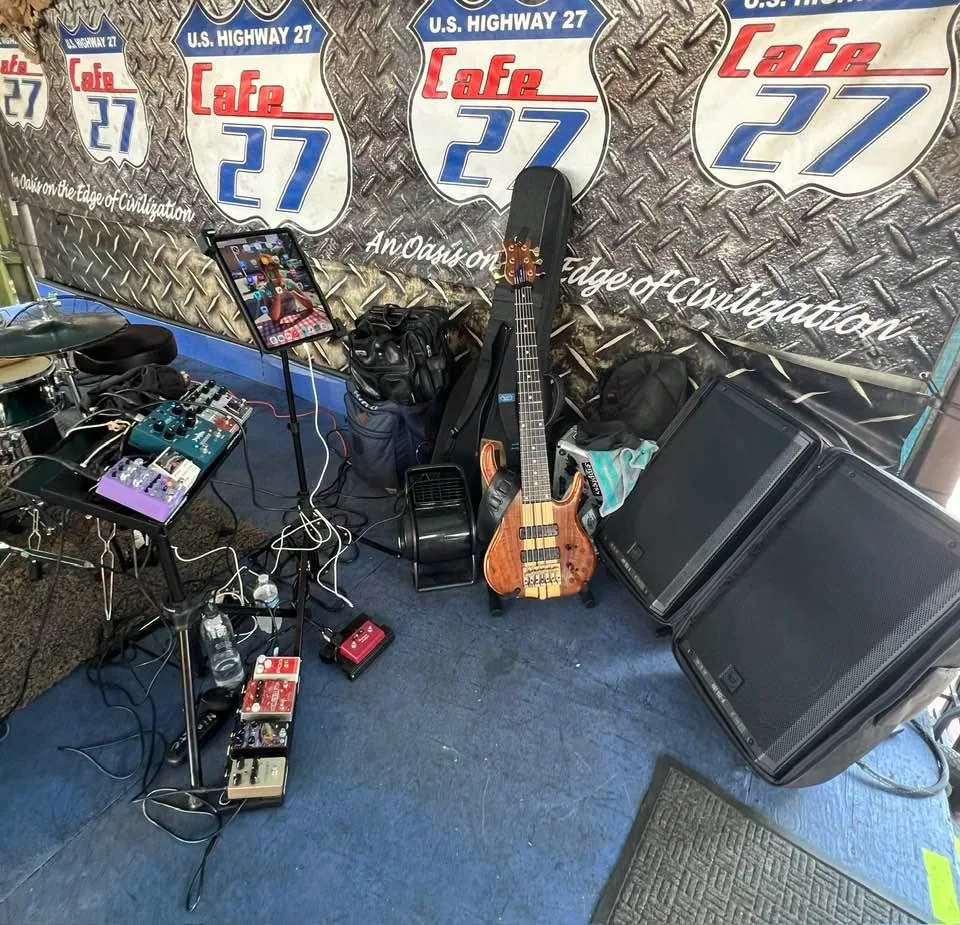
Russ doesn't use a traditional bass amp or cabinets. Instead, his rig is built from pedals and powered speakers, and it is what shows up on professional gigs, in studio sessions, and when teaching lessons over Zoom.
What Russ brings to a gig
For the sound engineer and the bandleader: what he sets up, and what he needs from the house.
- Amp on stage
- No traditional bass amp. His pedalboard is the amp.
- To the house
- One DI feed, from the Trickfish Minnow's DI out.
- His monitoring
- His own: RCF powered speakers, or in-ear monitors he mixes himself on a Mackie 402VLZ4.
- Wireless
- Sennheiser for the bass, Shure for the in-ears.
- Recording
- Straight into a DI box, or through the Micro-Thumpinator first.
The signal chain
Both basses run passive, so the whole tone is built here. The chain is the same on both boards, except that the Overdrive Preamp is on the rock and blues board only. Where the signal goes depends on whether he is playing live or recording, and each route below shows every connection in order.
- Optional on this gig
- Where the sound comes out
- Recording
Both outputs run at the same time. Parts in use: Bass, Micro-Thumpinator, VCA Compressor, Minnow, Front of house, External Pre Amp, RCF speakers or in-ears.
Both outputs run at the same time. Parts in use: Bass, Micro-Thumpinator, VCA Compressor, Overdrive Preamp, Minnow, Front of house, External Pre Amp, RCF speakers or in-ears.
The effects board patches in right before the Minnow, so the house and his ears both hear it. Parts in use: Bass, Micro-Thumpinator, VCA Compressor, Overdrive Preamp (optional), Pedalboard effects, Minnow, Front of house, External Pre Amp, RCF speakers or in-ears.
In the studio the DI box can go anywhere in the chain. Most often it takes the bass straight in, or after the Micro-Thumpinator, for the raw signal. Everything after the DI is for his own monitoring, with the Overdrive Preamp and the pedalboard there if he wants them. An engineer may also record the full rig as a reference, depending on the session. Parts in use: Bass, Micro-Thumpinator (optional), DI box, Recording console, VCA Compressor, Overdrive Preamp (optional), Pedalboard effects (optional), Minnow, External Pre Amp, RCF speakers or in-ears.
If needed, Russ can route a separate DI from anywhere in the signal chain to send a second line to the board, on request.

Basses
Two Ken Smith Black Tigers, a 2008 and a 2021. Russ removed the active electronics from both and runs them fully passive, directly into the output jack; everything else is done downstream.
His amp is a pedalboard
The board comes in two versions, and the gig decides which one comes out. The chain is the same on both. The only difference is the Trickfish Overdrive Preamp, which the rock and blues board carries and the jazz board leaves home.
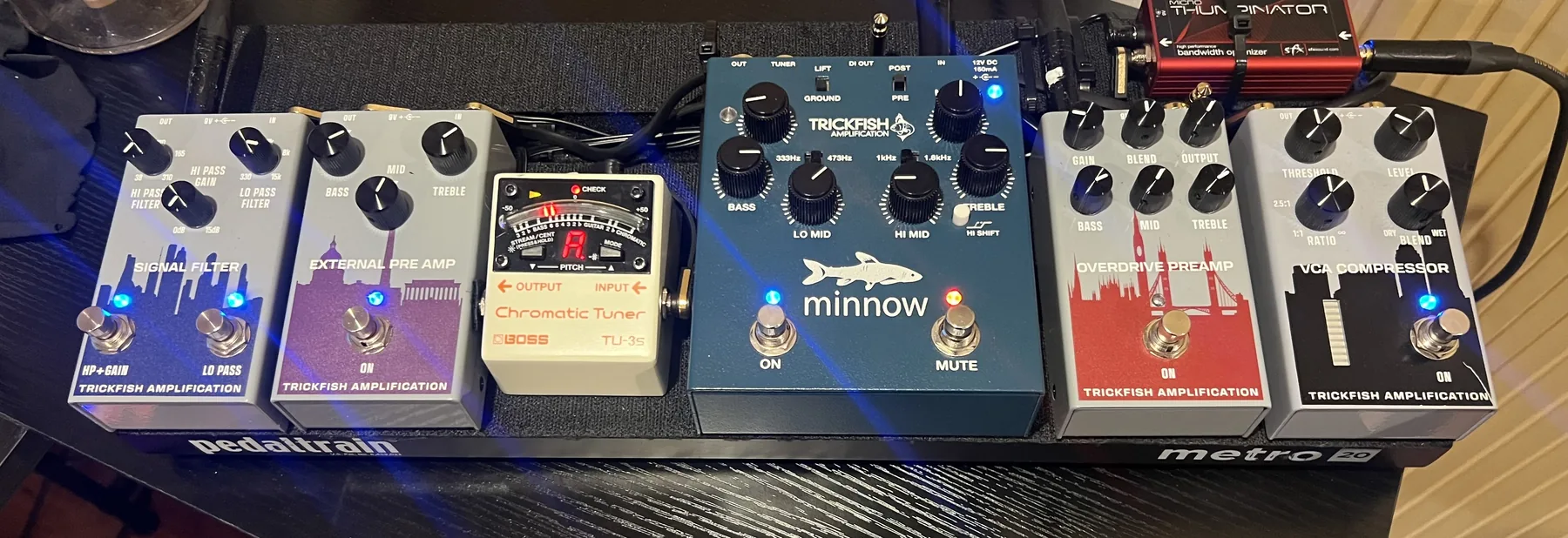
- SFX Micro-Thumpinator
- Trickfish VCA Compressor
- Trickfish Overdrive Preamp (rock and blues board only)
- Trickfish Minnow
- Trickfish External Pre Amp
- Boss TU-3S tuner
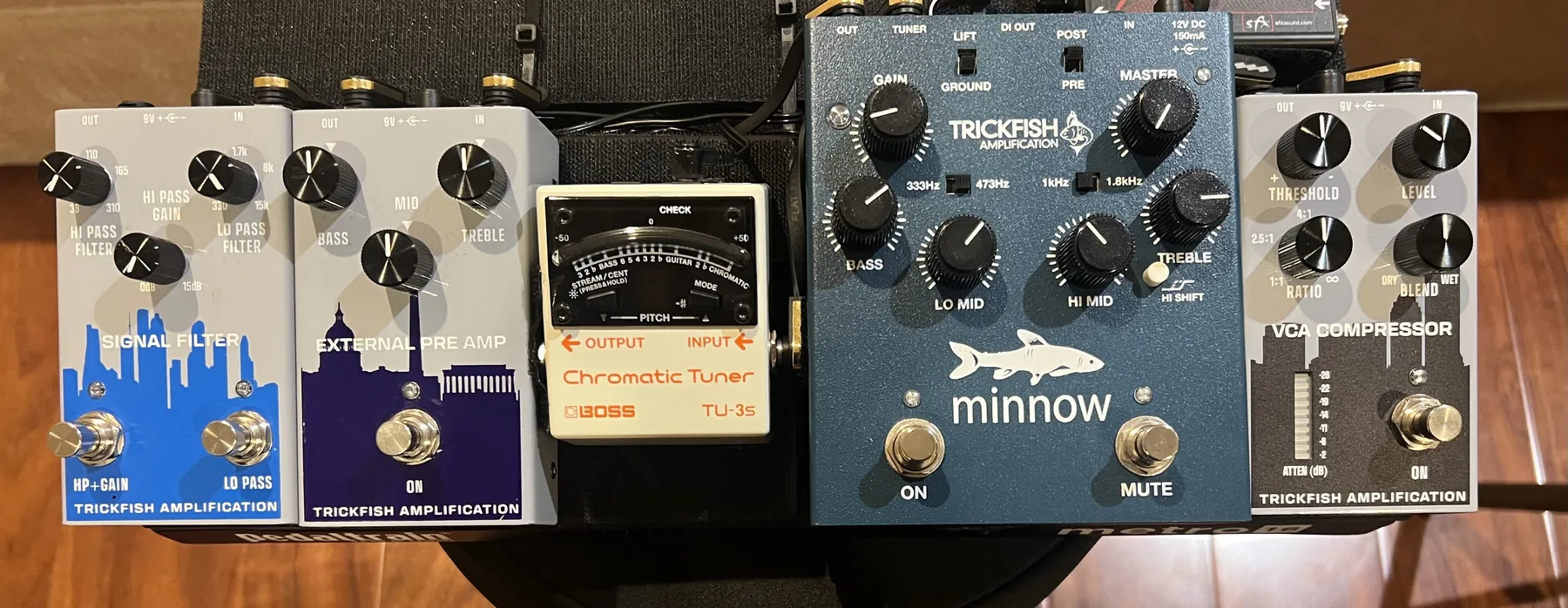
- SFX Micro-Thumpinator
- Trickfish VCA Compressor
- Trickfish Minnow
- Trickfish External Pre Amp
- Boss TU-3S tuner
Effects
A small Pedaltrain Nano board holds the color. It carries a UAFX Heavenly plate reverb, a Walrus Polychrome flanger, an Emma Electronic DiscumBOBulator auto-wah, and an Electro-Harmonix Nano POG octave. The board patches in between the overdrive preamp and the Minnow. An MXR Bass Synth patches in when a tune calls for it, rather than living on the board.

- UAFX Heavenly plate reverb
- Walrus Polychrome flanger
- Emma Electronic DiscumBOBulator auto-wah
- Electro-Harmonix Nano POG octave

To the house and his ears
Live, the board feeds the house and his ears at the same time. In the studio, the bass goes into a DI box on its way to the recording console, one of two ways.
Little or nothing sits between the bass and the DI, so the track is the raw bass, with any tone shaping left for the mix.
Russ still monitors through the rest of the board to his speakers or in-ears.
The External Pre Amp's bass, mid, and treble shape what reaches the speakers. If needed, an active volume pedal goes in before the speakers.
Speakers
In-ear monitoring
Russ runs on in-ears instead of stage volume, and mixes his own monitor. One wireless rig carries his bass and a second feeds his in-ears, and he builds the mix himself from a small mixer at his feet, so he hears exactly what he needs without leaning on the house or a monitor engineer.
- Session Ace ESA-V3 in-ear monitors
- Sennheiser wireless rig for the bass
- Shure wireless rig for the in-ear monitors
- Mackie 402VLZ4 mixer with an iPad for his personal monitor mix
- A BackBeat G2, a wearable transducer that lets him feel the low end through his strap instead of stage volume
Accessories
- Mogami Gold instrument and stage XLR cables
- Essential Sound MusicCord-Pro power cables
- Pedaltrain pedal boards
- A small pedalboard riser, for a single pedal on some jobs
- An active volume pedal, before the speakers when needed
- AirTurn BT-200 S-2 page turner
- Gruv Gear cart
The rig in the wild
A few nights out with the setup.
Explore
Want to talk gear and lessons with Russ?
Online bass lessons via Zoom for students of any level. Reach out to talk through your goals.